
"How long will this take?" is the first question every healthtech founder asks about EHR integration. The honest answer is: longer than your board deck says, but shorter than it has to be.
I've built EHR integrations at three different scales — from a single Epic connection at a radiology company to a multi-EHR platform processing millions of records daily at Phare Health. Here's what I've learned about realistic timelines, and where teams consistently lose time.
The Honest Timeline
For a typical Series A/B healthtech company building its first production EHR integration:
Optimistic (with experienced guidance): 8–12 weeks Typical (internal team, first time): 5–8 months Common reality (scope creep, no prior experience): 9–14 months
The gap between "optimistic" and "common reality" isn't about engineering talent. It's about knowing what to prioritize, what to skip, and where the hidden dependencies live.
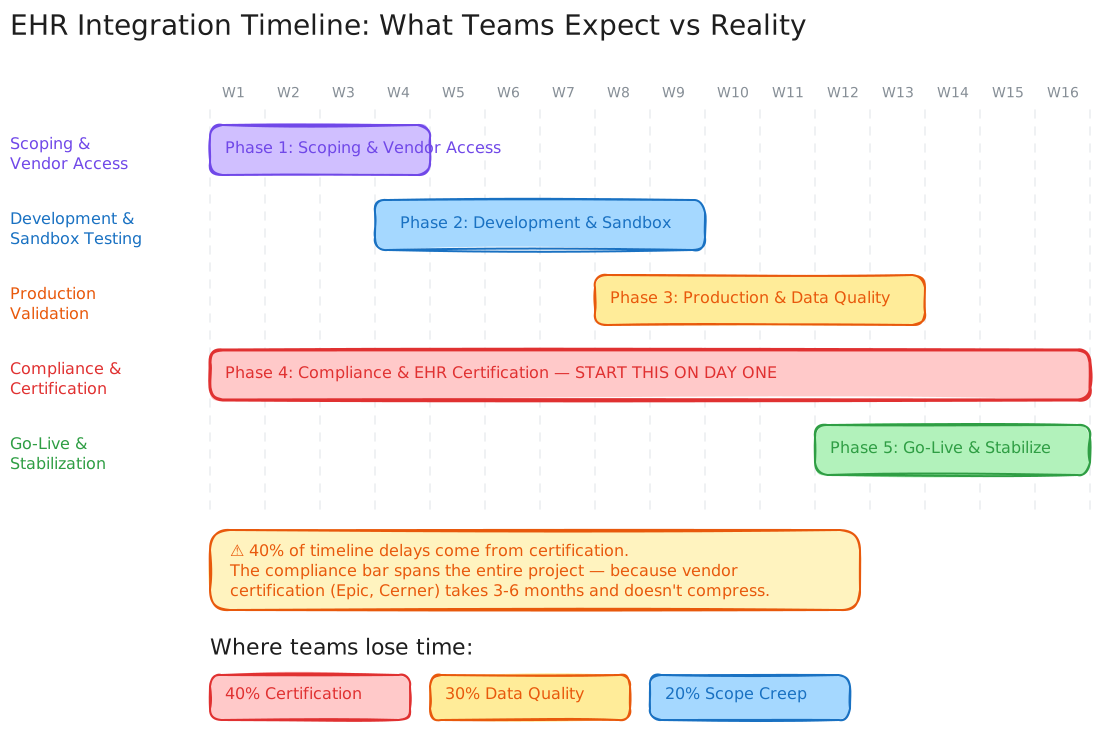
Phase 1: Scoping & Vendor Access (Weeks 1–4)
This is where most teams underinvest and pay for it later. Before you write integration code, you need clarity on three things: which EHR endpoints you actually need, what data you'll receive (and what you won't), and how to get access.
This phase involves identifying target FHIR resources and mapping them to your product requirements, applying for sandbox access (Epic App Orchard, Oracle Health/Cerner), reviewing the vendor's CapabilityStatement, drafting Business Associate Agreements, and defining your data model and transformation requirements.
Common time sink: Waiting for sandbox credentials. Some EHR vendors take 2–4 weeks just to grant developer access. Start this on day one.
Translation: the work you do in Phase 1 determines whether the rest of the project takes 8 weeks or 8 months. Don't rush past it.
Phase 2: Development & Sandbox Testing (Weeks 4–10)
This is the phase teams are most comfortable with — and where they tend to over-invest relative to other phases.
You're building your integration adapter (authentication, resource fetching, data transformation), implementing error handling and retry logic, setting up data validation gates, building your internal data model and storage layer, and testing against sandbox environments.
Common time sink: Over-engineering for edge cases before you've seen real production data. Build for the 80% case first. The edge cases will reveal themselves in Phase 3.
Translation: write less code than you think you need. Production data will tell you what's actually missing.
Phase 3: Production Validation & Data Quality (Weeks 8–14)
This is where timelines blow up. The sandbox data is clean, well-structured, and complete. Production data from a real health system is none of these things.
Running your pipeline against real clinical data for the first time is a humbling experience. You'll discover missing fields your schema assumed would always be present, inconsistent coding systems across departments within the same hospital, date formats that don't match documentation, and duplicate patient records that your deduplication logic can't handle.
Common time sink: Data quality issues that require pipeline redesign. At Phare, we built GPU-accelerated de-identification and NLP pipelines specifically because the volume and messiness of real clinical data overwhelmed simpler approaches.
Translation: budget at least 3 weeks for data quality iteration. If someone tells you "the data is clean," they haven't looked at it yet.
Phase 4: Compliance & Certification (Weeks 6–18, overlapping)
This runs in parallel with development but has its own timeline that you don't control.
Completing EHR vendor certification requirements, security review and penetration testing, SOC 2 evidence collection, HIPAA risk assessment documentation, and audit logging validation — each of these has its own cadence and review queue.
Common time sink: The vendor's review queue. Epic's certification process can take 3–6 months. Oracle Health has its own cadence. These timelines don't compress because you have a product launch date.
This is the single most important insight in this entire post: Start Phase 4 as early as Phase 1. Don't treat it as a final gate. The certification clock should be ticking before your first commit.
Translation: 40% of all EHR integration delays come from this phase. Start it immediately, run it in parallel with everything else.
Phase 5: Go-Live & Stabilization (Weeks 12–16)
Don't flip the switch all at once. A gradual rollout to production, with monitoring for data freshness, completeness, and pipeline failures, gives you time to catch issues before they affect patients.
This phase also includes incident response procedures and customer-facing documentation and support setup. Plan for a 2–4 week stabilization window where your team is on high alert.
Translation: "go-live" is a phase, not a moment. Plan for two weeks of intensive monitoring after you turn it on.
Where Teams Lose the Most Time
After watching this process play out many times, the biggest time losses come from three places:
Vendor access and certification (40% of delays). This is the single largest source of timeline risk because it's largely outside your control. The only mitigation is starting early and maintaining the vendor relationship actively.
Data quality surprises (30% of delays). The gap between sandbox and production data quality catches every first-time team off guard. Building data validation into your pipeline from the start dramatically reduces this.
Scope creep (20% of delays). "While we're integrating with Epic, let's also add Cerner support." This doubles the work without doubling the timeline budget. Integrate with one EHR first, stabilize, then add the next.
How to Compress the Timeline
The teams I've seen ship fastest share three habits:
Start vendor relationships before writing code. The certification clock should be ticking before your first commit. Every week you delay the vendor application is a week added to your go-live date.
Build for production data quality from day one. Don't wait until you see real data to add validation gates. Assume the data will be messy, and architect accordingly.
Scope ruthlessly. Your first EHR integration should support your core use case with one EHR vendor. Expansion comes after go-live, not during initial development. The teams that try to do everything at once are the teams that ship 9 months late.
With the right architecture decisions made upfront and an experienced guide, 8 weeks from kickoff to production is genuinely achievable. I've done it. But it requires discipline about scope, early vendor engagement, and an architecture that separates EHR-specific complexity from your core product logic.